
The Science of Wisdom
Why the oldest virtue may be the most urgent one today

The world is simultaneously facing many crises that humanity is failing to solve. Yet, at the same time, humans are smarter (with IQs on average thirty points higher than a century ago) and more knowledgeable (with the world’s knowledge base at our fingertips), and scientific advances are accelerating. However, intelligence and knowledge are not enough: wisdom harnesses these strengths to serve the common good. Education is focused on acquiring knowledge, but schools would do better also to teach and test for the development of wisdom. To a lot of people, wisdom is an abstraction, but there is a growing body of scientific research into what wisdom is and how it works. - Robert J. Sternberg, Professor of Human Development at Cornell University and former President of the American Psychological Association
There is a lot of talk today about inner development for outer change. What often gets overlooked is that the inflection point of the inner and the outer is decision-making itself. Our perception, emotional patterns, worldview, and self-awareness shape every decision we make. Decisions are the moments where inner life becomes outer action. We can build institutions, movements, and technologies, but what actually shapes the future is the choices made by individuals and groups. Think about it like this: EVERYTHING in human society is the result of someone who made a decision at some point, somewhere.
So the real question becomes: what helps us make “better” decisions, and what is even meant by “better”? This is where the science of wisdom enters. The science of wisdom studies how humans make balanced, context-sensitive, and ethically aligned choices, and why some people consistently make wiser decisions than others.
“Better” decisions are here understood as those that see the whole situation clearly, balance near-term and long-term implications, integrate multiple perspectives, regulate emotion without repression, and act in ways that support life. Intelligence and knowledge contribute, but they are not enough.
This is the paradox of our time. We live in an age of extraordinary intelligence and deep confusion. Our capacity to process information has exploded, yet our ability to make wise decisions has not kept pace. We can build systems of immense power but still struggle to use them well. Many now call this the metacrisis. It is not only a failure of technology or politics, but of perception and judgment. The Center for Humane Technology calls it the wisdom gap, mastery of creation without mastery of reflection.
Even the architects of advanced technologies are beginning to realise that their deepest challenges are human ones. What is missing is not more data or better strategy, but self-awareness, emotional depth, and clarity of perception. These are the qualities that shape the decisions leaders make every day. Satya Nadella recognised this when he rebuilt Microsoft’s culture around empathy and a growth mindset, a shift that helped transform the company. Wisdom is not soft. It is structural.
As machines take over more of our cognitive labor, wisdom becomes the defining task of human development. It is not an abstraction, but a practice of seeing clearly and acting coherently in uncertainty.
Every civilization has developed its own science of wisdom: systems for cultivating perception, judgment, and right-relationship. Indigenous knowledge systems, Confucian ethics, and Buddhist psychology have long integrated what we in the West separated into philosophy, psychology, and spirituality. Western science, in pursuit of objectivity, excluded the moral and subjective dimensions of knowing. That gave us immense power, but little understanding of how to wield it well.
Now, as the costs of that split become undeniable, Western research is turning its empirical gaze toward wisdom itself. Psychologists and neuroscientists are beginning to measure and map what other cultures have long treated as the foundation of a balanced life.
Studying wisdom through a psychological and Western scientific lens is valuable because science remains the dominant language of legitimacy in modern society. If we can empirically understand how wise reasoning operates, how people make balanced, compassionate, and context-sensitive decisions, we can begin to design education, leadership, and technology that cultivate those same capacities.
This is not an attempt to replace the deeper, ineffable, or spiritual dimensions of wisdom that many traditions hold sacred. Those dimensions remain essential. The scientific approach simply offers another lens, one that helps translate aspects of wisdom into forms that modern systems can recognise, work with, and support.
Translating the timeless pursuit of wisdom into measurable cognitive and behavioral processes allows us to connect ancient human insight with contemporary systems of knowledge. It also opens new frontiers. By understanding the psychological and neurocognitive foundations of wisdom, we can begin to ask what might make artificial intelligence wiser, not only more intelligent but more attuned to human values, ethical nuance, and the long-term flourishing of life itself.
This article offers a brief overview of key insights from the growing science of wisdom. It is not an attempt to cover the entire field or to define wisdom in all its facets, nor is it meant to speak for the many rich traditions that have cultivated it for centuries. Instead, it highlights how modern research has begun to illuminate, in scientific terms, what many cultures have long understood through experience and reflection.
The difference between wisdom and intelligence
If wisdom is so important, why have we understood it so little?
Western science has spent more than a century measuring intelligence, but it has barely studied wisdom. The distinction matters.
Intelligence, in the Western tradition, refers to the ability to reason, analyze, and solve problems efficiently. It values speed, precision, and control. IQ tests measure it through pattern recognition, memory, and computational skill.
Wisdom, by contrast, is the ability to see reality in context, to hold complexity, and to act in ways that serve the greater whole. Where intelligence manipulates information, wisdom integrates understanding.
Intelligence breaks problems into parts. Wisdom connects them. Intelligence seeks mastery over systems. Wisdom seeks harmony within them.
Western culture elevated intelligence because it aligned with the industrial and scientific aspirations. The traits that powered technological and economic progress, such as calculation, measurement, and efficiency, were those most easily observed and rewarded. Intelligence could be standardized, ranked, and optimized. Wisdom was harder to measure. It involved qualities such as humility, compassion, and discernment that did not fit within early scientific frameworks, and the surrounding societal aims.
As a result, wisdom was pushed to the margins. It survived in religion, philosophy, and the arts, while science focused on what could be counted.
Science catching up
In recent decades, researchers have brought wisdom back into the domain of western scientific research. Psychologists now treat it as a measurable form of human development that integrates cognition, emotion, and ethics. Three major models frame the field.
The Three-Dimensional Model (Monika Ardelt)
Wisdom is the integration of three interdependent capacities (Ardelt, 2003).
Cognitive: seeing reality as it truly is.
Reflective: examining one’s own assumptions and biases.
Compassionate: caring for others and acting with empathy.
When these three dimensions work together, intelligence becomes humane and self-awareness becomes transformative.
The Berlin Wisdom Paradigm (Paul Baltes and Ursula Staudinger)
Wisdom is a form of “expertise in the fundamental pragmatics of life” (Baltes & Staudinger, 2000). It is expressed through five observable qualities:
Rich factual knowledge about life and human nature.
Procedural knowledge for navigating complex situations.
Life-span contextualism, or the ability to consider past, present, and future simultaneously.
Value relativism, recognizing that different people and cultures hold different truths.
Acceptance of uncertainty, which allows for flexibility and humility.
In simple terms, wise reasoning requires holding multiple perspectives and acting with balance rather than certainty.
The Balance Theory of Wisdom (Robert Sternberg)
Wisdom is the ability to balance competing interests in pursuit of the common good (Sternberg, 1998). It involves:
Balancing self-interest, others’ interests, and collective interests.
Considering both short- and long-term consequences.
Using knowledge for actions that promote harmony and sustainability.
This model highlights wisdom as practical ethics in motion, grounded in discernment and responsibility.
Characteristics of wisdom
When neurologist Dilip Jeste and psychiatrist Thomas Meeks first reviewed the scimnetific literature on wisdom, they identified six core traits that appeared across almost every model of wisdom (Meeks & Jeste, 2009). Subsequent research led by Jeste and his team at the University of California, San Diego refined and expanded this framework into nine interrelated characteristics of wisdom, validated through behavioral and neurobiological studies (Jeste & Lee, 2013). These include:
social decision making/pragmatic knowledge of life
prosocial attitudes/behaviors
reflection/self-understanding
acknowledgment of and dealing effectively with uncertainty/ambiguity
emotional homeostasis
value relativism/tolerance
Openness to new experiences
Spirituality
Sense of humour
While there is not a consensus on what Wisdom is, these nine characteristics form the most comprehensive empirical model of wisdom currently in psychology and neuroscience. They describe a mature form of human functioning that unites reason and compassion, cognition and conscience. A wise person is not free from emotion or confusion, but relates to both with spaciousness and clarity.
Multiple ways of knowing
A core insight emerging across cognitive science is that human understanding is not built from facts alone. Western culture has long privileged propositional knowledge, the kind that can be stated, tested, and stored, but wisdom draws on a wider set of capacities. John Vervaeke’s work offers a useful framework here, identifying four distinct ways of knowing that together shape how we make sense of reality (Vervaeke, 2020).
Propositional knowing refers to knowledge about facts and concepts. It provides clarity and coherence. It is essential for shared language and accurate reasoning, yet it often remains abstract. Knowing the definition of compassion does not mean we can enact it. Knowing the principles of good leadership does not mean we can embody them.
Procedural knowing is knowledge of how to do something. It includes skills such as listening well, de-escalating conflict, negotiating, or navigating ethically complex situations. These forms of know-how are often tacit. They are learned through practice and participation rather than through theory alone.
Perspectival knowing refers to the felt sense of being in a situation. It includes situational awareness, emotional attunement, embodiment, and the ability to understand what is relevant in the moment. Perspectival knowing shapes how the world “shows up” to us. Two people can face the same external conditions but experience entirely different realities based on this layer of knowing.
Participatory knowing is the deepest layer. It concerns the way we perceive ourselves as being in relationship with the world. It includes identity, belonging, intuition, purpose, and the felt sense of right relationship. Participatory knowing helps orient us toward meaning and coherence. It shapes what we care about and what we take to be worth acting on.
Wisdom emerges when these four ways of knowing harmonise. Without propositional clarity, our interpretations become confused. Without procedural competence, insight cannot be enacted. Without perspectival awareness, we misread context and misinterpret others. Without participatory grounding, our actions lose meaning and direction.
The science of wisdom increasingly shows that wise judgment depends on the ability to move fluidly among these modes of knowing. Wise individuals are not simply more informed. They are more attuned. They can sense what matters, understand a situation in context, act with skill, and remain grounded in a deeper sense of connection and purpose.
Seen in this light, wisdom is not a single trait but a synthesis of multiple ways of knowing that together support clear perception and coherent action. When these ways of knowing fall out of balance, our decisions narrow. When they align, our decisions become more humane, more farsighted, and more fit for the complexity of the world we now inhabit.
Measuring wisdom
Although wisdom has often been viewed as ineffable, modern psychology has developed reliable ways to study and even quantify it. Researchers now measure wisdom through three main approaches (Glück et al., 2017).
1. Self-report scales
These rely on introspection and personal reflection. Instruments such as Ardelt’s Three-Dimensional Wisdom Scale (Ardelt, 2003) and Webster’s Self Assessed Wisdom Scale (Webster, 2007) asks individuals to rate statements about empathy, open-mindedness, and emotional regulation. Such measures capture how people perceive their own capacity for wisdom and how they interpret their inner experience.
2. Performance-based measures
These evaluate how people actually reason through complex, real-world dilemmas. The Berlin Wisdom Paradigm, developed by Paul Baltes and Ursula Staudinger, presents participants with hypothetical life problems such as how to advise a friend in a moral conflict. Their responses are rated for perspective-taking, contextual awareness, and tolerance for uncertainty.
3. Social reasoning and situational tasks
Recent work by Igor Grossmann and colleagues uses wise reasoning paradigms that analyze how people discuss interpersonal or societal conflicts. This method views wisdom as a process that depends on context and emotion, showing how situational factors can strengthen or weaken wise judgment.
Because self-perception and behavior often diverge, the most accurate assessments combine these approaches. Together they show that wisdom is not a fixed trait but a dynamic capacity that can expand or contract depending on context, reflection, and emotional balance.
Cultivating Wisdom
Across cultures, humanity has cultivated remarkably sophisticated technologies of wisdom. From the meditative sciences of India and Tibet, to the moral cultivation of ren in Confucian thought, to Indigenous practices of ecological attunement, countless traditions have mapped how insight deepens, how self and world become integrated, and how care is translated into action. The scope of this piece is not to capture that vast heritage. It is simply a brief overview of what contemporary western science has begun to uncover.
Generally, the scientific literature distinguishes between two different modes of wisdom cultivation:
Short-term practices help people connect with the wisdom they already hold. Researchers studying wise reasoning, such as Igor Grossmann, Monika Ardelt, and Judith Glück, have identified several ways to temporarily widen perspective.
Self-Distancing: Reflect on a personal challenge as if you were advising someone else. Instead of asking “What should I do?”, ask “What should [Nico] do?” or “What would I tell a friend in my place?” This third-person reflection reduces emotional bias and increases humility and empathy. Experiments show it reliably enhances wise reasoning (Grossmann & Kross, 2014).
Cloud Ride: Imagine rising above the situation and viewing it from a cloud, seeing all perspectives at once. This metaphor, used in cross-cultural wisdom research, helps people consider issues through multiple cultural or contextual lenses. In studies, participants who used this “view from above” made more integrative and compassionate judgments (Grossmann et al., 2016).
Imagined Dialogue: Engage in an inner conversation with a wise figure such as a mentor, ancestor, or your future self. This draws on dialogical self theory, which treats inner dialogue as a way to surface different self-positions and perspectives, improving self-understanding and tolerance for ambiguity (Hermans & Gieser, 2012).
Long-term cultivation involves gradual structural changes in how people learn from experience. Decades of psychological and neurobiological research point to several reliable pathways.
Openness to Experience: Longitudinal studies identify openness as one of the strongest personality predictors of wisdom development. People who remain curious and receptive to new perspectives accumulate broader life knowledge and cognitive flexibility (Ardelt, 2003; Staudinger & Glück, 2011).
Reflective Processing of Life Events: Research on post-traumatic growth and lifespan development shows that individuals who reflect deeply on difficult experiences—and integrate them into a coherent life story—display higher wisdom scores (Glück & Bluck, 2018).
Emotion Regulation and Compassion Training: Contemplative and mindfulness-based practices strengthen neural circuits related to emotional balance and empathy, both key components of wisdom (Meeks & Jeste, 2009).
Purposeful Mentorship and Prosocial Engagement: Wisdom tends to emerge in contexts where individuals serve or guide others. Studies show that mentoring, teaching, or caregiving fosters perspective-taking and ethical reasoning (Staudinger et al., 2005).
In sum, wisdom does not automatically come with age or intelligence. It grows through reflection, compassion, and deliberate engagement with life’s complexity.
Cross-cultural perception of wisdom
Recent cross-cultural research has begun to empirically map how people around the world recognize wisdom. A 2024 Nature Communications study led by Maksim Rudnev and Igor Grossmann examined 16 samples across 12 countries and five continents, asking participants to evaluate themselves and others on 19 wisdom-related traits. The findings reveal two core dimensions that together form a near-universal structure of wisdom perception: Reflective Orientation and Socio-Emotional Awareness (Rudnev et al., 2024).
1. Reflective Orientation – clear seeing
Metacognition: thinking about one’s own thinking; recognizing biases and limits.
Perspective-taking across time: drawing lessons from past experience and anticipating long-term consequences.
Emotional regulation: staying balanced under stress or uncertainty.
Deliberation before action: pausing to reflect rather than reacting impulsively.
2. Socio-Emotional Awareness – deep caring
Empathy and compassion: caring for others’ well-being.
Humility: recognizing one’s fallibility and learning from others.
Context sensitivity: attuning to the subtleties of relationships, social cues, and cultural norms.
Connection to something larger: nature, community, or the sacred.
Three findings matter for a science of wisdom:
Two dimensions, one template. The same two latent dimensions showed up across languages and regions. Reflection was strikingly stable across cultures. Socio-emotional awareness varied more by local norms, yet remained part of the shared template.
Integration predicts “wise.” Participants rated targets as wisest when both dimensions were high. Reflection appeared necessary. High caring without reflective rigor often read as kind but not wise. High reflection amplified by socio-emotional awareness read as wisdom in action.
The self-other gap. People tended to see themselves as less reflective but more socio-emotionally attuned than exemplars. This bias suggests why we overestimate our warmth and underestimate the disciplined practices that cultivate judgment.
Implications for practice:
Design for balance. Train both cognitive reflection and relational attunement. Programs that teach one without the other will underperform.
Measure both. Use assessments that track growth on reflective skills and socio-emotional capacities, then their interaction.
Localize the social layer. Keep reflection standards consistent, but allow socio-emotional expression to be contextually shaped by culture, role, and setting.
In short, wisdom is not only how we think or how we care. It is the fit between clear seeing and deep relating, held together in real decisions under uncertainty.
The biology of wisdom
Brain imaging studies show that wisdom is not located in a single region of the brain. It emerges from a distributed network that connects systems responsible for cognition, emotion, social reasoning, and self-awareness.
Neuroscientists Dilip Jeste and Thomas Meeks identified several regions that work together when people engage in wise reasoning (Meeks & Jeste, 2009).
The prefrontal cortex, particularly the dorsolateral and ventromedial areas, supports planning, judgment, and emotional control. It helps people weigh competing values and resist impulsive reactions.
The anterior cingulate cortex monitors conflict and maintains emotional balance. It enables a person to tolerate ambiguity and remain steady when decisions are complex.
The insula links bodily awareness with empathy. It allows internal sensations to inform understanding of other people’s feelings.
Later research found that other regions also contribute to wise reasoning. The temporo-parietal junction is involved in perspective-taking and understanding others’ mental states. The default mode network, which integrates self-reflection, memory, and moral awareness, appears to be active when people think about ethical dilemmas or long-term consequences (Thomas et al., 2019).
Together these regions form a network that mirrors what wisdom represents psychologically: the integration of multiple ways of knowing. Cognitive, emotional, and social circuits must work in harmony rather than in isolation. Wisdom arises when these systems communicate effectively, creating a kind of neural coherence that allows perception, feeling, and action to align.
In biological terms, wisdom is not about suppressing emotion or relying only on intellect. It is about connection among systems that usually operate separately. When these systems are synchronized, people can think clearly, stay emotionally grounded, and act with compassion even under pressure.
Neuroscientists describe this as a state of dynamic balance. The wise mind can shift flexibly between analysis and empathy depending on what the situation requires. This capacity for coordination, rather than sheer intelligence or moral intent, may be the most accurate biological signature of wisdom.
A path forward for Wisdom
Western science has spent more than a century perfecting ways to measure intelligence while neglecting wisdom. The result is a civilisation rich in information and poor in understanding. We learned to predict outcomes, but not to live with uncertainty.
Other cultures never made this separation. Their sciences of wisdom were woven into daily life, transmitted through story, ceremony, and relationship to place. In those traditions, wisdom is a collective property that keeps systems in balance. It is both empirical and sacred (Abas et al., 2022; Jessen et al., 2022).
The modern study of wisdom is now beginning to reconnect these worlds. Over the past three decades, research in psychology and neuroscience has established wisdom as a measurable integration of cognitive, emotional, and ethical capacities that enable sound judgment within complexity. At the same time, new initiatives are broadening the field beyond its Western foundations. Projects such as Igor Grossmann’s Wise Judgement project explore cross-cultural expressions of wise reasoning, while collaborations between Indigenous and academic researchers are beginning to frame wisdom as both relational and developmental, not only individual and cognitive.
In this convergence lies the next horizon of wisdom science: a field that honours data and meaning alike, combining empirical methods with the lived traditions that have studied wisdom for millennia. To face the metacrisis, we must bring these worlds back together. Wisdom can once again become both scientific and soulful. It can be measured and practiced, studied and lived.
Wisdom is what allows power to serve life rather than consume it. It is the faculty that can potentially help our civilization find its way home.
—--------
A lot of the information here is from evidencebasedwisdom.com, which is an amazing resource for anything related to scientific research on wisdom run by Charles Cassidy. Highly recommend people that are interested to check out their work alongside the On wisdom podcast with Igor Grossman
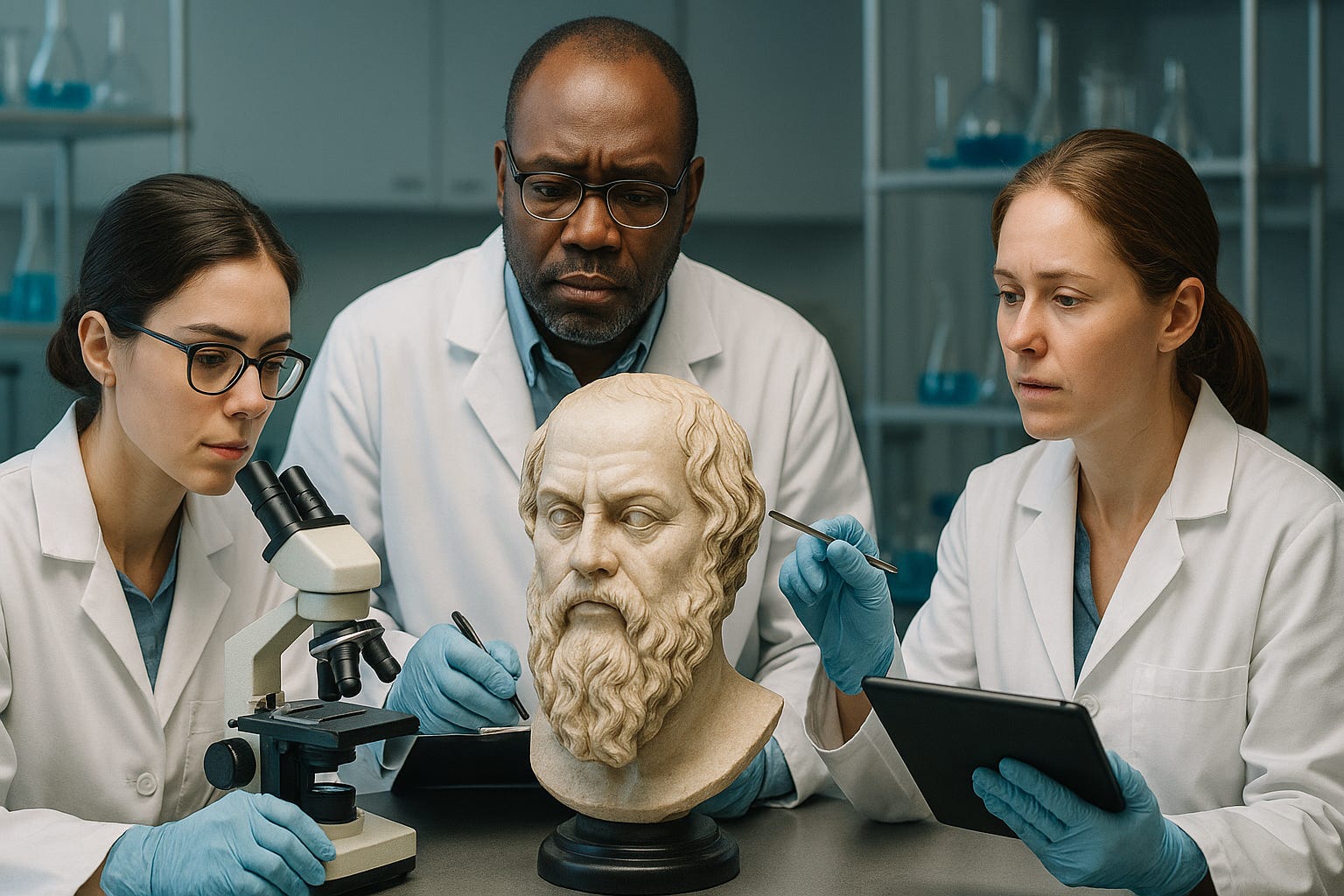
“To face the metacrisis, we must bring these worlds back together. Wisdom can once again become both scientific and soulful. It can be measured and practiced, studied and lived.”
Yes!
Thanks for sharing this collection of scientific studies and for your reflections.
Nicholas,
Thank you for this thoughtful, in-depth, and wise analysis of wisdom!
For me, the concept of wisdom first arose in my awareness as a rebellion against the voices that proclaim artificial intelligence can replace humans in the workplace. As you clearly articulate, intelligence and wisdom are not the same. While AI can replace human intelligence, it cannot replace human wisdom.
This let me to my research, resulting in the recent publication of "Leading into the Age of Wisdom: Reimagining the Future of Work." Our Industrial Age model of organization assumes wisdom resides in the few rather than acknowledging that wisdom is in all of us. A reimagined future of work is formed around the latter understanding. It recognizes that a culture of belonging--where everyone is valued and invited to share their wisdom--is not a good idea or a politically correct move, but rather is a strategic advantage. It rethinks org design applying thinking such as network science so that the organization is dynamic, ever-changing in response to internal and external stimuli. It puts aside the thinking that all work is place-bound. It recognizes that the metric of time is a false measure for productivity. Work is accomplished, results are achieved, through mental, physical, emotional, and spiritual energy. Monitoring energy cycles and enabling energy restoration become important elements of the culture. Finally, a reimagined future of work incorporates ways to capture collective wisdom, bringing decision-making to all levels of the organization as appropriate.
It is with this in mind that I have become an advocate for all of these changes in my own work, including the incorporation of Wisdom Circles into organizational practice. A Wisdom Circle is not about advice-giving or problem solving. Rather, it is a practice of collective discernment, a space to listen, reflect, and uncover deeper insights.
Thank you for raising the voice of wisdom. May we, and others, continue to do so.